

On Dec 21st, Ambassador Khaled Ahmad Zekriya met with President of the Foreign Affairs Committee at the Chamber of Deputies, H.E. Piero Fassino. The two discussed issues related to the OIC meeting, the formation of an inclusive representative government in Afghanistan and combating humanitarian crisis in the country.
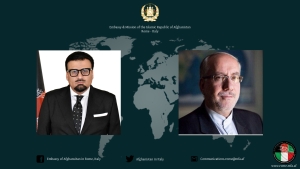
Today, Amb Khaled Ahmad Zekriya paid a courtesy visit to H.E. Hamid Bayat, Ambassador of the Islamic Republic of Iran to Rome. The two discussed various bilateral issues, particularly the formation of an inclusive representative government in Afghanistan.

Yesterday, H.E. Ambassador Khaled A. Zekriya attended a working luncheon, organized by chair of ESCAP in Rome, to bid farewell to the Ambassador of Vietnam in Rome, H.E. Nguyen Thi Bich Hue, and Ambassador of South Korea, H.E Hee-seog Kwon.

Today, H.E. Ambassador Khaled A. Zekriya met and bid farewell to H.E. Hee-seog Kwon, Ambassador of South Korea, whose tenure is coming to an end in February, 2022. Ambassador of Afghanistan thanked Ambassador Kwon for his service, friendship, and wished him all the very best in his new assignment.
Announcement
Please be informed that the Embassy of the Islamic Republic of Afghanistan and its Consulate in Rome, will be closed on Tuesday, 15 February 2022, due to the 33rd Anniversary of the Withdrawal of the Soviet Troops from Afghanistan. The Embassy and its Consulate will resume services on Wednesday, 16 February 2022.

بسم الله الرحمن الرحیم
First and foremost, I would like to Thank HE the Prime Minister of the Republic of Iraq to convening today’s session in Baghdad.
Mr. Chairperson,
Mr. Director General,
Independent Chairperson of the FAO Council,
Chairperson of the Committee of the World Food Security,
Distinguished Members of the Near East Conference,
Ladies and Gentlemen,
Good afternoon.
It is a great pleasure for me to attend on behalf of the Islamic Republic of Afghanistan today’s session.
As you may be aware, successive decades of war and insecurity, annual cycles of natural disasters, worst drought on record in the last 27 years, an ongoing pandemic, and deep-rooted poverty, have left over half of the population of Afghanistan in critical need of humanitarian assistance.
Nearly 6 months since the Taliban seized power by force, Afghanistan is on the brink of a mass starvation, which threatens to kill 1 million children this winter, a toll that would dwarf the total number of Afghan civilians estimated to have been killed as a direct result of the war over the past 20 years.
While Afghanistan has suffered from malnutrition for decades, the country’s hunger crisis has worsened under the Taliban. This winter, an estimated 22.8 million people, more than half the population, are expected to face potentially life-threatening levels of food insecurity. Of those, 8.7 million people are nearing famine.
According to the UN, since my country is confronting one of the worst droughts in decades, it has withered fields, starved farm animals and dried irrigation channels. Afghanistan’s wheat harvest is expected to be as much as 25 percent below average this year. In rural areas, where roughly 70 percent of the population lives, many farmers have given up cultivating their land.
Mr. Chairperson,
Distinguished Delegates,
For decades, small farmers and rural communities survived the winters on stored wheat from their summer harvest and the income from selling onions in the market. But this year yielded barely enough to sustain families during the fall months. Without food to last this winter, some Afghans have migrated to cities hoping to find work or to other districts to depend on the help of relatives.
Now with the freezing winter, as it was alluded earlier that humanitarian organizations are warning that 1 million children could die, and millions of other Afghans will be forced to choose between migration and starvation, it is vital to engage and empower indigenous actors at the community level to work toward inclusive and sustainable programs, which could bring together local actors to identify and address needs that can help rebuild disrupted communities and relationships. Humanitarian agencies should also advocate to the international community for the resumption of essential food trade with Afghanistan and invest in programs to promote linkages between development assistance and humanitarian response, especially with an emphasis on disaster risk reduction resilience and building of vulnerable communities against shocks. Additionally, the stabilization of Afghanistan's food markets is essential for the well-being of the population, particularly for households facing food deficits. Functional food markets and the ability to pay local suppliers will make humanitarian response more effective. Lastly, ensuring adequate monitoring of food insecurity and malnutrition during the winter season.
Mr. Chairperson,
Distinguished Colleagues,
In conclusion, since Afghanistan does not have a robust framework of solutions on food security to be implemented, especially with its low budget and the wide range of security, political, economic, and social challenges, the food crisis in Afghanistan is one of the most crucial issues that requires immediate solutions. Hence, building resilience is an imperative to achieve economic development and contribute to building peace in Afghanistan. Moreover, there is an urgent need to create pathways between FAO and other near countries to create opportunities to build more inclusive, resilient, and sustainable agri-food system for Afghanistan.
Thank you.
بسم الله الرحمن الرحیم
Honorable Senator Bonfrisco,
Honorable Undersecretary Mule,
General Battisti,
Dear Panel Participants,
Distinguished Guests and Colleagues,
Ladies and Gentlemen,
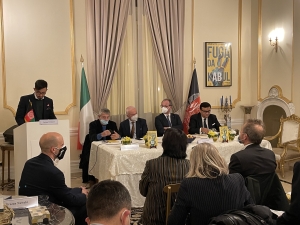
Good evening and welcome to the embassy of the Islamic Republic of Afghanistan.
First and foremost, my appreciation goes to Paesi Edizioni and to Ms. Giselle Chatsa for initiating and coordinating tonight’s event with our embassy for the presentation of the book written by General Battisti titled Fuga da Kabul. I am also indebted to General Battisti’s continued support and friendship as well as attending tonight’s book presentation.
Before starting my talk, I would also like to take this opportunity to express our gratitude to our allies and partners, including Italy in the last 20 years for their sacrifices both in blood and treasure rendered in Afghanistan. Let me assure you the 54 brave Italian’s who lost their precious lives for safeguarding our shared democratic values, the republic, human rights, and the fight against terrorism were not in vain. We cherish their memories, and their sacrifices will be marked as immortal in the contemporary history of Afghanistan.
At this juncture, let me also thank the international community, the international organizations, non-governmental organizations, the media, and other members of civil society-indigenous or non-indigenous-for their continued support in area of humanitarian assistance and humanitarian evacuation as well as reporting the human rights violations by the Taliban in Afghanistan.
In view of the 15 minutes allotted to me, tonight:
- First, I will briefly talk about Taliban’s claimed foreign policy.
- Second, I will provide you with some of the Taliban’s strategies of how they want to stabilize their power in Afghanistan and beyond.
As a former student of Structural School of Political Science, where Structural School adopts more of a macro perspective or global definition of foreign policy, the primary and essential ground for a government to develop foreign policy is to have a State, and a government in a territory cannot exist without the legal existence of a State. Therefore, Taliban’s claim to representing a state and develop independent foreign policy becomes problematic.
For this reason, the Taliban do not have a white paper or a codified foreign policy guide and won’t have one in the foreseeable future.
The Taliban’s commitment to a foreign policy of neutrality, non-interference and self-reliance also falls short when looking at their political attitude and behavior in Afghanistan. In the last six months despite some of their overtures and rhetoric, the Taliban’s foreign policy fall into the category of what I call a “Client State Foreign Policy”, which is conceptualized as not having full autonomy to prepare and conduct the government's foreign policy actions. Because of this, the Taliban are dependent in matters of political, financial, logistic, military, and intelligence on their client state as well as being under the influence of their terrorist affiliates such as Al Qaeda, and other terrorist groups.
Additionally, the Taliban’s foreign policy becomes more problematic for the following reasons:
1st. They do not have a state due to not having a ratified and applicable constitution, thus lacking constitutional legitimacy.
2nd. They do not have professional cadre and avoid trusting former civil servants; thus, making institutional entities dysfunctional where they cannot deliver services to the public. They lack what is referred to as “performance legitimacy”. Lack of performance legitimacy questions their claim to internal legitimacy and effective control of Afghanistan.
3rd. They cannot conduct relations with other states due to not having diplomatic recognition and not having jurisdiction and access to Afghanistan’s missions abroad including our embassy and mission here in Rome.
4th. They are fully dependent on their Client State and other terrorist affiliates, to lobby on their behalf and guide them as to how to conduct their foreign relations. Hence, they lack sovereignty and independence.
5th. They do not believe in a government bureaucracy, because most of their holders of authority still believe in upholding their ideals of being an insurgent Islamist movement.
6th. The continued presence of al-Qaeda in Afghanistan and the emergence of ISIS pose major problems for the Taliban’s foreign relations. Though they have assured the international community that the Afghan territory will not be used against international community, their linkages with these terrorist affiliates makes most foreign governments skeptical of such assurances.
Lastly, the Taliban foreign policy claim to power is based on having control over Afghanistan’s full territory and their interpretation of security is solely physical security, which deconstructs Roseau’s Social Contract. As my journalist colleague Giuliano says: The Taliban’s social contract with the Afghan population is predicated on that they will give the Afghan public security, and in return determine they demand their loyalty and determine their freedom and rights based on Taliban’s Sharia Law.
Now that I have reached the Second part of my talk, I will provide you with some of the Taliban’s strategies of how they want to stabilize their power. The following Taliban strategic initiatives instructed by their client state and affiliates, which is very similar to 1996 when they came to power, merit attention:
- The first initiative of the Taliban is to use the humanitarian assistance for their own benefit as well as the benefit of their client state and terrorist affiliates. Taliban are diligently trying to influence and even pressure the international community to provide them with direct or semi direct access to humanitarian aid as well as hire their own Taliban members and Pakistani professional at UN agencies and NGOs to distribute and monitor aid to Afghans.
- Their second initiative has to do with the fact that they want to exert pressure on the international community that if they want the humanitarian assistance and evacuation to continue, the western nations must provide them with various diplomatic and financial incentive such as diplomatic recognition.
- Third strategic initiative is the cultivation of energy companies and energy pipelines such as TAPI, TAP, CASA1000, Lapis Lazuli etc. to collect revenues. This is a repetition of 1995 policies with the US corporation UNOCAL and the Saudi corporation Delta Oil for the construction of a gas pipeline through Afghanistan to Pakistan.
- Taliban’s other strategic initiative is related to the exploitation of 'transit trade route' for their sponsor and allies such as Pakistan and China and other interested neighbors. This will allow China to have its export and import transported through Afghanistan for less cost. Pakistan also wants to have direct and full connectivity to Central Asia.
- Fifth initiative is to keep India as far as possible and try to isolate India from all the regional connectivity projects to allow China and Pakistan’s strategic interest to prevail in Afghanistan, the region and beyond.
- Sixth strategic initiative relates to raising of the revenues from opium. Opium represents a revenue source for the Taliban in Afghanistan. As the Taliban are continuing to extract revenues from this source, they are looking at ways and means of not alienating foreign governments.
- Seventh, the Taliban’s strategy approach on gender egalitarianism or equality is based on giving excuses and delaying tactics via their strategic communication. The Taliban are trying to minimize the international community’s demand from the formation inclusive government and not using the Afghan soil against any other country, to allowing girls and women to school and higher education. Taliban consider today’s women a serious danger-a force that can challenge or even change-the course of their action and authority to rule the country.
- Eight, the Taliban’s relation with UN agencies, regional organization, NGOs, and foreign media is very important. Hence, the Taliban have been instructed to give a better image of themselves to the wider world through these important channels. While some NGOs and foreign journalists welcome the security which the Taliban bring and finds them less corrupt than some other groups, the issue of gender has made them rethink their considerations about the Taliban.
- Ninth, is the strategy to support and assistance from the US and EU. Despite the war of words with the US by saying that they have defeated US and NATO in Afghanistan, they continue to talk and negotiate with the US and some of her allies to gain recognition and support.
- Tenth, the Taliban strategy is trying to exchange of incentives such as trade and transit rights, underground exploration rights, water resource access, international airport management and security contracts, and allowance of completing fence construction on the Durand Line as a first step to recognizing as a de jour border between Afghanistan and Pakistan to get diplomatic recognition from Pakistan and other natural and near neighbors.
- Eleventh, the Taliban are institutionalizing insurgency tactics such as suicide bombing by creating “Martyrdom Brigades” as part of the nation army under the control of the ministry of defense of Afghanistan. The Martyrdom Brigades will be used for special military operations. However, this is a sort of institutionalized state terrorism is only for show of dominance and hegemony to some natural and near neighbors and in due course of time will serve Taliban’s expansionist Emirate aspirations.
- Twelfth, the Taliban are employing a new strategy with some of our natural and near neighbors to send some of their newly appointed diplomats to various countries, where the Taliban have not been recognized no one. They are also using disgruntled and disenfranchised former diplomats to conduct raids and infiltrate Afghanistan foreign missions to have full access and control of them. Their latest announcement that they will be providing salaries to Afghan foreign missions diplomats is indicative of wanting to gain loyalty from these diplomats.
- Lastly, the Taliban are beginning to encourage international community to invite them to participate in conferences and meetings to not only gain optic and coverage as a form of legitimacy, but also debunk the importance of the UN and US Sanction and Blacklist.
All in all, Taliban’s unique foreign affairs conduct and their strategies are not going to work, because the current humanitarian crisis; humanitarian evacuation (leading to Brain drain); socioeconomic degradation, lack of effective delivery of services to the public; strong fragmentation amongst Taliban leaders, rank, file and foot soldiers; existing rivalries between Taliban and other terrorist groups; the presence of pocket of resistance, including the national resistance front of Afghanistan that might lead to an overall national resistance; lack of internal and external legitimacy including diplomatic non-recognition; imminent threat coming from narcotics and terrorism; and changes in regional dynamics makes the collapse of the Taliban regime most probable. Therefore, with this probable scenario of collapse, we must have a viable, legal, and national contesting power to fill the power vacuum when collapse occurs. Also, at this juncture an international peace keeping, and monitoring body is deemed necessary to allow Afghanistan to go from an interim government toward the formation of a representative inclusive government, which the Taliban will be a part of.
Thank you.
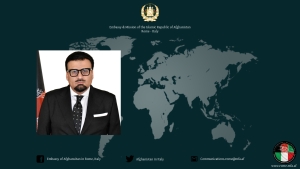
Today Ambassador Zekriya met President Lorenzo Trucco and Vice-President Nazzarena Zorzella of The Association for Juridical Studies on Immigration (ASGI), to discuss humanitarian corridors and to explore new viable platforms for addressing the current humanitarian crises in Afghanistan.
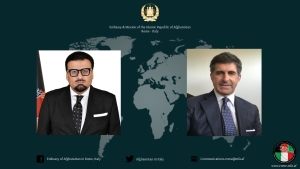
On January 27th, H.E. Ambassador Zekriya had a productive meeting with Serbian Ambassador to Rome, H.E. Goran Aleksić, on further enhancement of cooperation between the two missions here in Italy and particularly on the pitiful issue of two deceased Afghan nationals in Serbia.
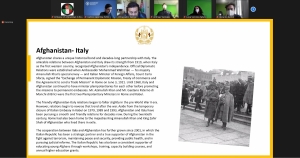
Today Ambassador Zekriya gave a virtual presentation about the past, present and future of Afghanistan with a particular focus on Afghanistan - Italy bilateral ties throughout the history. The lecture was organized by the Manfredo Fanti High School with the cooperation of FAO.
